Moon Sweepers Store Check: 16-Player Co-op and a Toothbrush
This is a store-data check of Moon Sweepers, not a hands-on review — every claim below comes from the official Steam listing (AppID 5335510), verified today, and nothing here reflects play time.
The pitch
<figcaption>Official Trailer — Moon Sweepers, DragDrop Games. Source: Steam AppID 5335510 (checked 2026-10-25).</figcaption>
</figure>

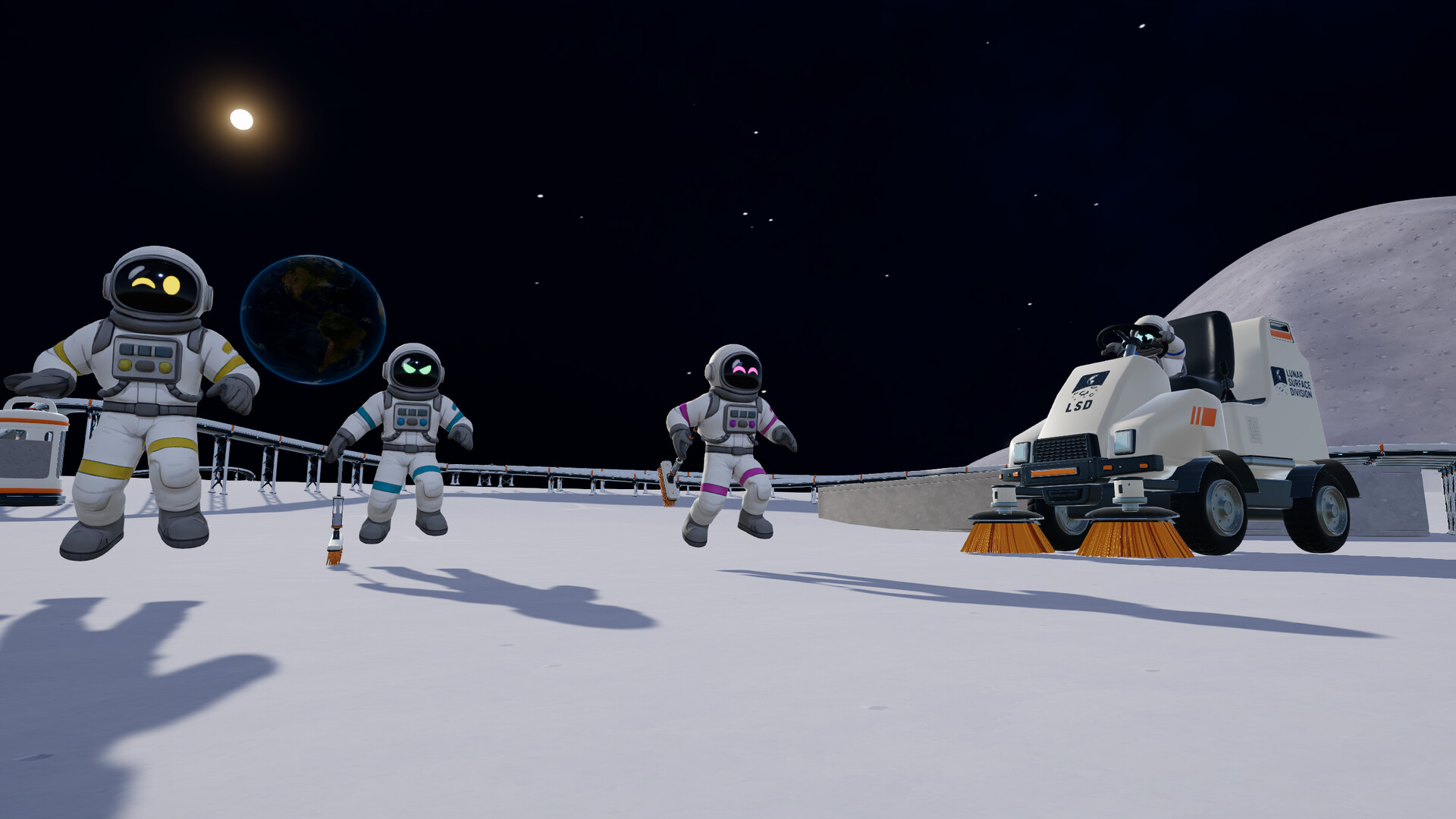
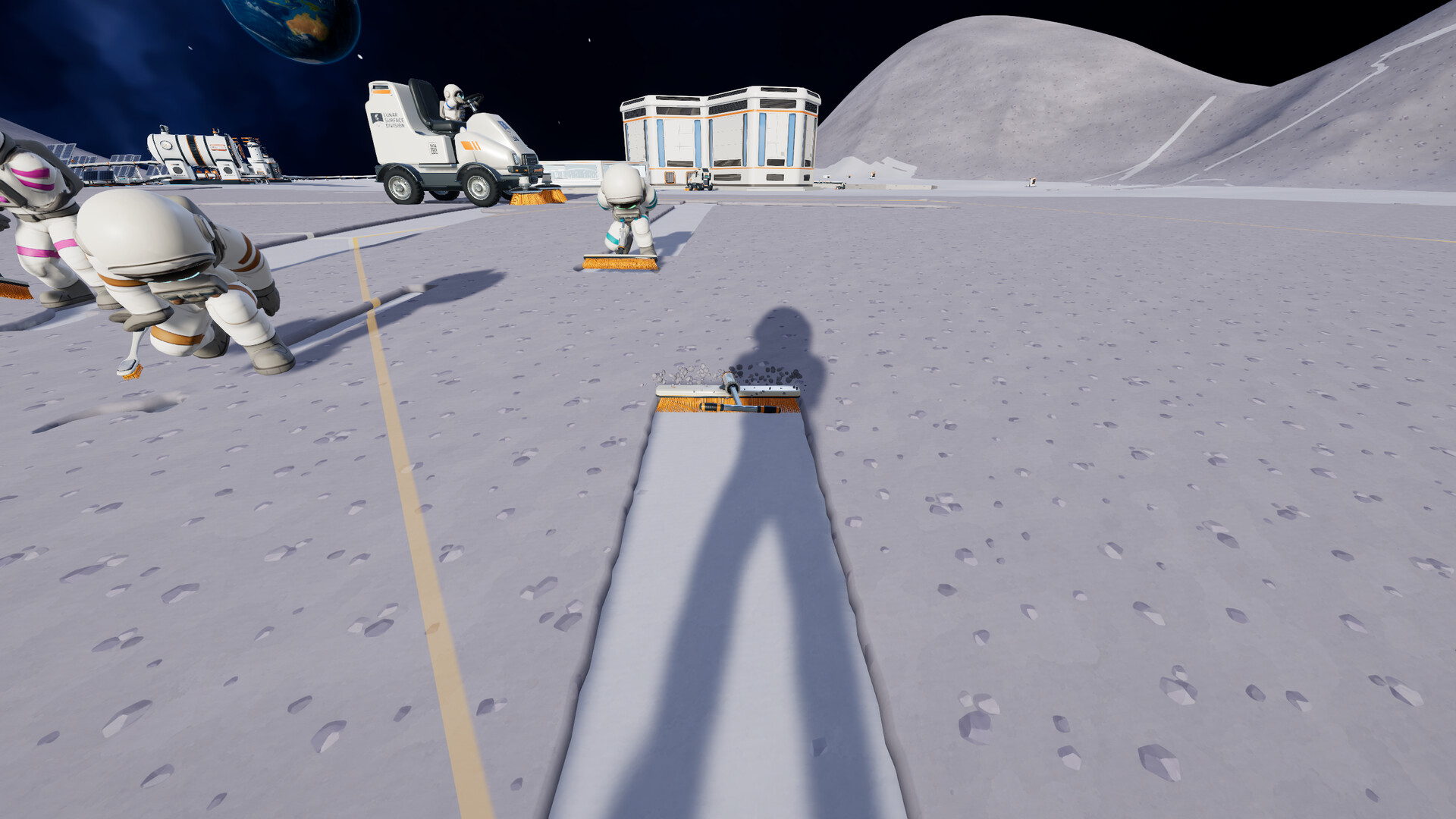
The listing opens with a premise that doubles as a joke: the Moon is covered in dust, the Lunar Surface Department sent you and your crew to clean it, and the budget only covered a toothbrush.
That single sentence carries the entire product. The game is a cleaning job, the job is absurdly large, and the equipment is comedically inadequate. Everything else on the page — collecting dust, selling it, buying better tools, upgrading equipment — is the standard incremental loop attached to that joke.
The escalation path is explicit: turn an underfunded cleanup mission into a growing operation, one painfully small brushstroke at a time.
It is worth naming the mechanism plainly, because the store page does not spell it out. An incremental game works by converting repetitive low-value action into currency, then converting currency into tools that raise the value of the same action. The joke and the loop are the same shape here: the toothbrush is the starting tool, the dust is the currency, and the upgrade tree is the budget you were never given. That is why the premise reads as more than a gag — it is a reskin of a proven structure, and the reskin is unusually well chosen. Most incremental games ask you to accept an abstract number going up. This one asks you to accept that a government department sent a crew to sweep a celestial body with a toothbrush, which is funnier and, in a deadpan way, more believable.
The scale mismatch is the engine. A toothbrush against the lunar surface is a ratio so bad it becomes comic, and every upgrade in the chain is a small, satisfying correction to that ratio. The page frames the arc as turning an underfunded cleanup mission into a growing operation, which is the standard fantasy of the genre — starting with nothing, ending with infrastructure. What the listing does not do is quantify any of it. There are no numbers on the page for dust collected, upgrade tiers, or time-to-completion, so the pacing is something you find out by playing, not by reading.
The 16-player question
The most load-bearing number on the page is the lobby cap. The listing promises online co-op for up to 16 players, with the option to spread out across the surface or work the same area together.
Sixteen is unusual and it cuts both ways. It makes the premise funnier and more social — a shift crew of sixteen scrubbing dust is a stronger image than four. It also creates the coordination cost that every large-lobby game inherits: sixteen people at $7.64 each means assembling a group is now a scheduling project, not an impulse purchase.
The listing anticipates this with a line that reads like a design confession: there is enough dust to keep everyone busy, and whether everyone actually works is another matter. That is honest about the failure mode.
There is a second-order effect worth flagging. Sixteen-player co-op is a technical promise as much as a social one: the game has to keep sixteen clients in sync while they either scatter across the surface or crowd the same patch. The listing offers both modes, which suggests the design anticipates groups that split up and groups that cluster, but it does not say how the dust economy scales with headcount — whether sixteen sweepers each earn their own progress or share a pool. That detail matters more than it sounds, because in a co-op incremental game the difference between shared and separate progression decides whether a large lobby feels like a team or like sixteen people playing alone in the same room. The page is silent on it, so treat the 16-player figure as a stated cap, not a verified experience.
Store facts, verified
- AppID 5335510, Windows only
- $7.64, no Mac or Linux build
- Released October 23, 2026 — two days before this check
- Genres tagged Action, Adventure, Casual, Indie, Simulation, Strategy
- Developer and publisher both listed as DragDrop Games
- Fifteen screenshots on the store page, two trailers (Teaser, Trailer)
- No public demo listed
What the page does not say
Two things matter and neither is on the listing. First, whether the lobby is joinable solo or expects a crew. An incremental loop can work alone, but the 16-player framing signals that the social layer is the point. Second, whether the dust economy has an end. A cleaning game either reaches a satisfying completion or collapses into an endless grind, and the page describes growth rather than a finish line.
The two trailers are the best available evidence for tone. The teaser and the main trailer are both on the store page, and they carry more information about the actual feel than any bullet point.
A third gap is worth adding to the list: the genre tags. Six tags — Action, Adventure, Casual, Indie, Simulation, Strategy — is a broad spread for a game whose pitch is a single loop. That breadth is normal on Steam, where tags are partly a discoverability tool, but it tells you the developer is hedging on how the game should be filed. A cleaning incremental with action and strategy tags implies there is more moment-to-moment activity than the toothbrush joke suggests, or that the tags are aspirational. Either way, the tag list is not a description of the game; the pitch paragraph is.
The absence of a demo is the other practical gap. At two days past release, a demo would be the cheapest way to answer the solo question and the pacing question at once, and there isn't one listed. That leaves the trailers as the only pre-purchase evidence of feel, which is why they carry outsized weight in this check.
The price question
$7.64 is a co-op tax, not a solo price. Sixteen players is $122 of group spend, which is not a lot for a night of collective comedy but is a real commitment if the game only holds attention for an hour.
That is the honest risk here. The premise is strong, the price is low, and the loop is proven — but the value depends entirely on whether the group shows up and whether the joke survives repetition.
Put the number in context. $7.64 sits in the impulse band for Steam, below the point where most buyers read reviews first, and that is clearly the intent: the price is set so that the joke can close the sale on its own. But the math changes with the lobby size. A full sixteen is $122, which is roughly the cost of a group dinner, and the comparison is fair — you are buying a shared evening, not a solo hobby. The failure case is specific and predictable: a group buys in on the strength of the toothbrush line, plays for an hour, laughs, and never returns. At that outcome the price is still defensible as the cost of a night's entertainment, but it is not defensible as the cost of a game you will keep playing. The distinction matters because the listing sells the premise harder than it sells longevity.
Verdict
Buy if you can assemble a shift. The 16-player cap is the reason to pick this over a dozen other incremental co-op games, and the toothbrush joke is good enough to justify the $7.64 on its own. Wait if you play alone; nothing in the listing promises the game is designed for one.
https://store.steampowered.com/app/5335510/